The Conference Is Coming to the Shore Where the Problem Lives
There is something different about this year’s Our Ocean Conference. Something that changes the nature of the conversation before a single delegate takes the stage.
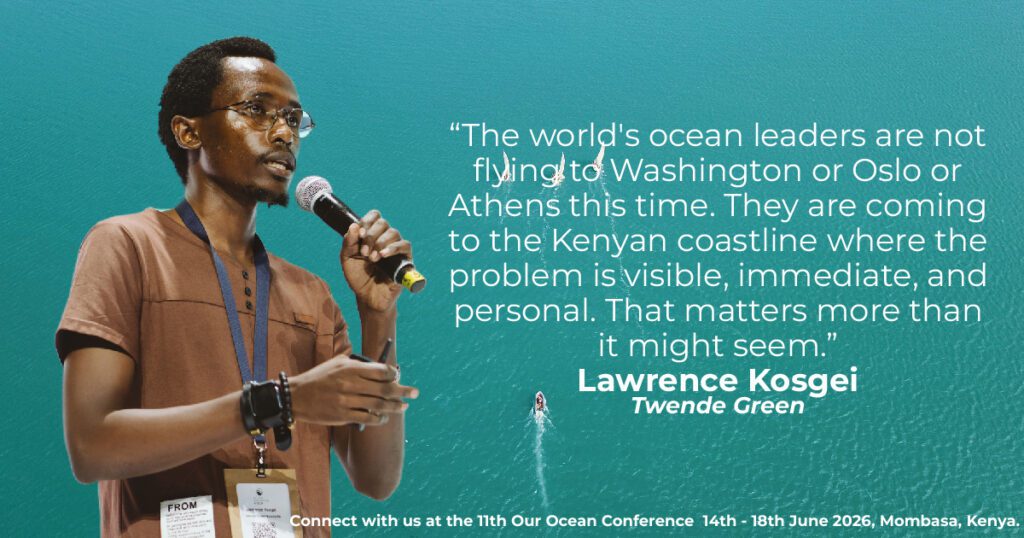
It’s happening here. In Mombasa. On the shore of the Indian Ocean — the same ocean that has been quietly absorbing the consequences of our plastic economy for decades. The world’s ocean leaders are not flying to Washington or Oslo or Athens this time. They are coming to the coast where the problem is visible, immediate, and personal.
That matters more than it might seem.
We are Twende Green Ecocycle. We were born from these shores — from the place where the Indian Ocean meets Kenyan communities, where beauty and plastic waste exist uncomfortably side by side. We are a social enterprise based in Mombasa, Bamburi, and what we do is not complicated to describe: we collect ocean-bound plastic waste, we process it, and we turn it into furniture. School desks. Lecture hall chairs. Durable, affordable pieces that go into classrooms in communities that need them.
That’s the loop. Plastic that was heading for the ocean becomes a desk in a school. A desk that will outlast any wooden alternative, survive pests and water and the hard use that comes with children who have nowhere else to sit. Two problems, one solution.
But the reason we are writing this now — the reason this moment feels significant to us — is that the 11th Our Ocean Conference, running June 16 to 18, 2026, is the first time this global gathering has ever set foot on African soil. And it is landing in our city.
Let’s be honest about what the plastic crisis actually looks like from where we sit.
Africa generates 17 million tonnes of plastic waste every year. Less than 10 percent of it is recycled. The rest goes somewhere — landfills, open burning, drainage ditches, rivers, and eventually the ocean. Kenya alone generates over a million tonnes of plastic waste annually. We are not a marginal contributor to this problem. We are inside it.
And Mombasa sits right at the end of the pipeline. Plastic that enters a river in Nairobi, hundreds of kilometres inland, does not stay in Nairobi. It travels. It finds water. It follows the drainage systems down toward the coast. By the time it reaches the Indian Ocean — our ocean — nobody who dropped it can see where it went. There is no feedback. No consequence visible to the person who created the problem. The communities on the coast are left holding it.
This is what ocean-bound plastic actually means. It is not plastic already floating in the sea. It is plastic that has not yet arrived — but is on its way. The window to intercept it is real, but it is short.
We work in that window.
What we have learned — from the ground, from doing this work, not from reading about it — is that the answer to ocean-bound plastic is not cleanup after the fact. You cannot fish enough plastic out of the Indian Ocean to solve this. The ocean is vast and plastic is relentless. The answer is interception. Catch it before it gets there. Give communities an economic reason to treat plastic as a resource rather than waste. Build systems that pull plastic out of the environment and give it somewhere better to go.
That is precisely what we do. We recover plastic from coastal areas and community hotspots — the places where pollution is most severe, where waste sits uncollected because formal systems haven’t reached. We process it. We manufacture from it. The desk in a classroom in an underserved Kenyan school is made from plastic that would otherwise have entered this ocean.
We are not just cleaning up. We are rerouting the pipeline.
The Our Ocean Conference, since its founding in 2014, has generated over 2,900 voluntary commitments — pledges from governments, businesses, and institutions — worth roughly $169 billion for ocean protection globally. That is not nothing. Commitments made at this conference have expanded marine protected areas, pushed back on illegal fishing, funded ocean science, and kept the pressure alive on a global plastics treaty.
But there has always been a gap between commitment and implementation. A gap between what gets announced in a conference hall and what actually changes on a shoreline. We know that gap well. We operate inside it.
What is different about OOC11 — what we believe makes this edition more significant than its predecessors — is the location. Hosting this conference in Mombasa forces a reckoning. The delegates will arrive at an airport in a city where plastic pollution is not a future risk or a distant concern. It is outside. It is in the waters they may choose to swim in. It is in the fish that local communities eat. The problem is not being discussed from a comfortable remove. It is everywhere the conference happens to be.
There is a kind of clarity that comes from proximity. It is harder to be vague when the evidence is sitting on the beach.
We showcased our recycled plastic school desk to King Charles III during his visit to Kenya. Former US Ambassador to the United Nations Samantha Power has described our model as “a practical circular economy model that turns pollution into opportunity for communities.” We have been recognised among 100 innovators shaping Africa’s Blue Economy. We have been featured on WION International News.
We mention these things not to impress. We mention them because they point at something real: a circular economy model built here, on this coast, by people who live with this ocean, is drawing global attention. Not because it is exotic. Because it works.
The model is simple enough to explain in a sentence. Ocean-bound plastic becomes raw material. Raw material becomes furniture. Furniture goes into schools that cannot afford the wooden alternative. Communities that participate in collection earn livelihoods. The ocean gets less plastic. Students get desks. That is a circular economy. Not a theory. A thing that is actually happening.
The global plastics treaty — the legally binding international agreement that would finally set real rules around plastic production, chemicals, and accountability — is still being negotiated. The last major session ended without consensus. The next round is expected later in 2026. The Our Ocean Conference is not the treaty. But it shapes the pressure around it. Every commitment made in Mombasa this June raises the floor of what countries and corporations believe they can get away with. That matters.
And yet, the treaty — whenever it comes — will not solve this by itself. Treaties do not collect plastic from the shoreline. Policies do not process waste. Commitments do not manufacture desks. Those things require organisations, people, and systems actually doing the work.
We are one of those systems. Based in Bamburi, Mombasa. Working in the communities closest to the water. Turning the plastic that this ocean does not want into something the next generation does.
The Our Ocean Conference comes to the shore where the problem lives. That is not a small thing. For years, the conversation about ocean plastic has happened far from the places where ocean plastic is actually a daily reality. This June, the conversation moves. It comes to us.
We will be there. Not as observers. As people who have been doing this work before the cameras arrived, and who will still be doing it after the delegates go home.
If you want to understand what it looks like to intercept ocean-bound plastic before it reaches this ocean — to close the loop between waste and value, between pollution and possibility — we are here.
Come find us. Or reach out directly.
info@twendegreen.co.ke
+254741027140
The ocean is not somewhere else. It is here. So are we.