

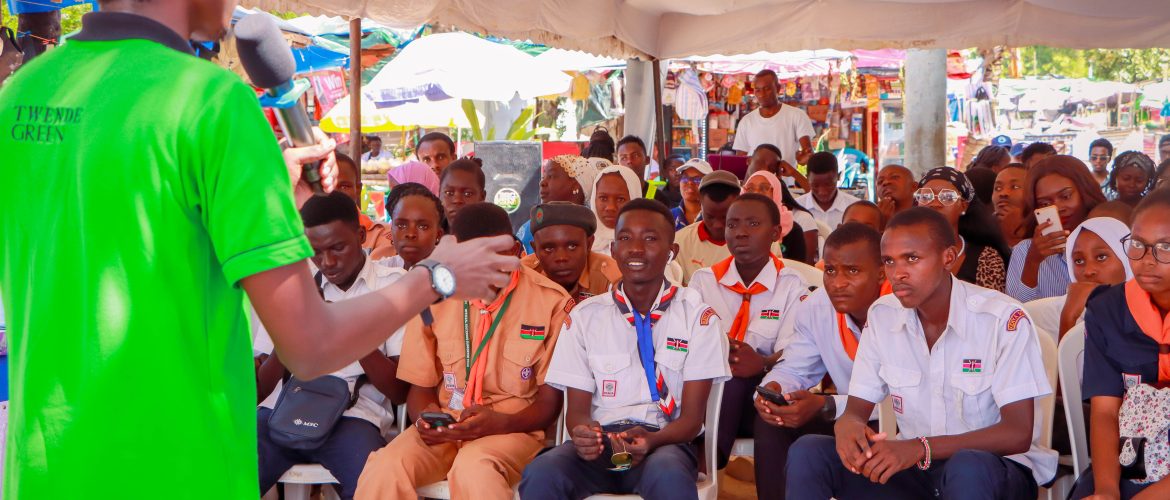
First, let me start this article by saying that we did not set out to be “innovators.” We set out to survive.
I am a founder at Twende Green Ecocycle. And today, we have been selected among 100 Innovators Shaping Africa’s Blue Economy.
People congratulate us, yes. They call it a milestone. They say it is proof that young Africans are leading change.
But I want to say something uncomfortable.
We did not start Twende Green because we wanted recognition.
We started because our beaches were drowning in plastic, and landfills were stoked with piles of it.
In Mombasa, plastic waste is not a distant environmental headline. It is what you step over on your way to the ocean. It is what fishermen pull up instead of fish. It is what children burn in open spaces because there is no proper waste system. It is what washes back to shore every single morning, no matter how much we clean.
We have removed tonnes of plastic from our coastline, last year it was over 60 tonnes. We have transformed waste into school furniture. We have mobilized volunteers. We have stood in the sun for hours cleaning beaches that should never have been polluted in the first place.
And yet the plastic keeps coming.
So yes, we are proud to be recognized among 100 innovators shaping Africa’s Blue Economy. But this recognition is not a celebration of success. It is a warning.
It is proof that the system is failing.
Because why are young people forced to clean up what corporations continue to produce without limits?
Why are coastal communities managing waste they did not design, did not profit from, and cannot control?
Why are political leaders still approving projects that increase plastic production while speaking about sustainability on global stages?
We are told the “blue economy” is the future. We are told it will create jobs, protect ecosystems, and unlock growth. But an economy built on polluted oceans is not blue. It is broken.
There is nothing innovative about cleaning up plastic that should never have existed.
There is nothing visionary about turning waste into desks while the production of single-use plastics continues to rise.
We can recycle. We can upcycle. We can educate. But if production does not slow down, if corporations are not forced to take responsibility, we are simply managing a crisis that is being constantly refilled.
This is not just about litter. It is about power.
Plastic pollution in Africa’s coastal communities is tied to global systems of extraction and inequality. Multinational corporations profit from cheap production. Weak regulations allow products to flood markets without accountability. Waste management systems are underfunded. Informal waste workers carry the burden without protection or fair pay.
Meanwhile, press releases talk about commitments and roadmaps.
We do not need more commitments. We need consequences.
The human cost of this neglect is real.
When marine ecosystems collapse, fishermen lose income. When beaches are polluted, tourism suffers. When plastic is burned, communities inhale toxic fumes. When microplastics enter the food chain, they enter our bodies.
This is not theoretical. It is happening now.
As young people, we are often praised for being passionate. But passion is not the point. Survival is.
We refuse to inherit an ocean that has been treated as a dumping ground. We refuse to accept that economic growth must come at the expense of our health and our ecosystems. We refuse to be patient while the damage accelerates.
Twende Green Ecocycle exists because of community. Volunteers who show up before sunrise. Youth who believe their actions matter. Schools that accept furniture made from recycled plastic and understand the story behind it. Coastal residents who know that protecting the ocean is not optional—it is personal.
But community action cannot replace political responsibility.
If leaders are serious about protecting Africa’s blue economy, they must legislate bold limits on single-use plastics. They must enforce extended producer responsibility so companies pay for the full lifecycle of their products. They must invest in real waste infrastructure that protects both people and ecosystems.
And corporations must stop hiding behind sustainability campaigns.
Do not sponsor a beach cleanup while increasing plastic output.
Do not publish glossy impact reports while lobbying against regulation.
Do not use the language of circular economy while maintaining linear profit models.
If your business model depends on endless production and disposal, then it is incompatible with a living ocean.
Being named among 100 innovators does not mean the problem is being solved. It means communities are stepping in where systems have failed.
We will continue to clean beaches. We will continue to transform waste into opportunity. We will continue to educate and mobilize. But we will also continue to demand accountability.
Because the ocean cannot defend itself in boardrooms.
Children in coastal Kenya cannot vote in international negotiations.
Future generations cannot negotiate with plastic already in the water.
So this recognition is not a finish line. It is a platform.
A platform to say clearly: Africa’s coastline is not a sacrifice zone. Our communities are not collateral damage. Our oceans are not marketing tools.
If you are a policymaker, regulate boldly.
If you are a corporation, reduce production drastically and redesign your systems now — not in 2040, not in 2050.
If you speak about the blue economy, start by protecting the blue.
We are honored to be counted among 100 innovators. But what we truly want is not applause.
We want systemic change.
Less plastic produced.
Stronger laws enforced.
Communities funded and protected.
Oceans restored.
Not symbolic gestures. Not pilot projects. Not empty promises.
Real change.
And we will not stop demanding it.
No comments yet.